Research and Process
Reading the Manual as Motive
CDC response trees. Motorway design standards. Immigration casework software. Crypto thermal loads. Clark studies how harm is formatted, then writes the breach.
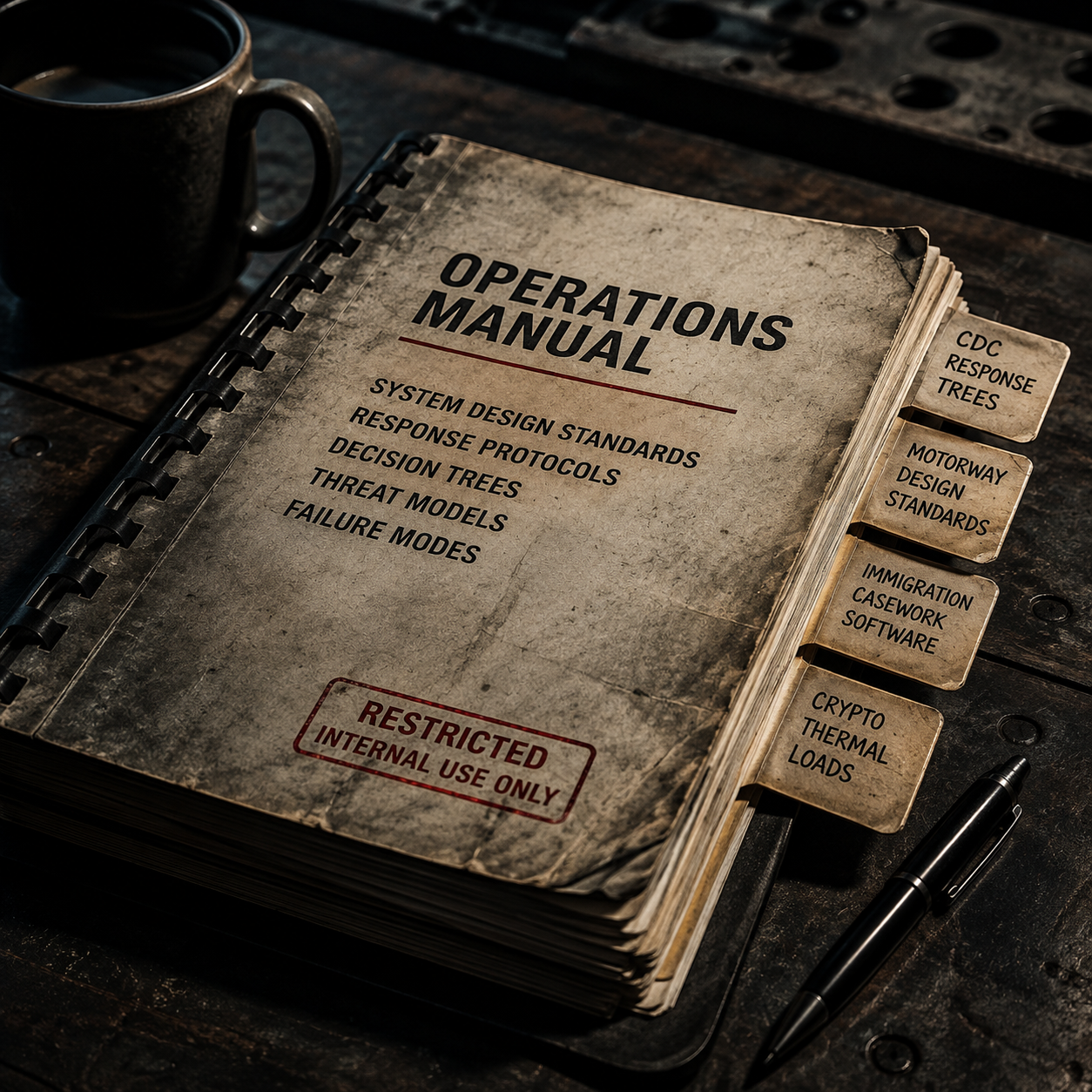
A system reveals itself most clearly in the documents it believes no ordinary person will ever read.
Manuals, standards, process maps, software screens, technical specifications, and operational guidance can look lifeless from the outside. They are built to reduce uncertainty, enforce order, and make complicated work repeatable. For a novelist, that is exactly what makes them useful.
Every formal process contains assumptions about who belongs, what counts as normal, which failures matter, and who is expected to absorb the damage when something goes wrong. A thriller does not need to invent those pressures from nothing. Often, they are already sitting inside the structure.
The work begins by reading the manual closely enough to see where procedure ends and motive begins.
The hidden narrative
Systems tell stories before characters do
A response tree shows who is contacted first, who is authorized to act, and which failures are considered acceptable. An engineering standard defines the tolerances a structure can survive. A casework platform turns a life into fields, flags, queues, and status codes. A thermal specification identifies the point where a machine stops functioning safely.
Each document appears neutral. None of them are neutral.
They contain a model of the world. They define what the institution expects to happen, which exceptions deserve attention, and which people or outcomes can be pushed outside the frame.
Once those choices become visible, the document stops being background research. It becomes a map of pressure, motive, and opportunity.
Procedure and consequence
Harm is often formatted before it is delivered
Institutions rarely describe harm in direct language. They record it as delay, load, threshold, reassignment, deviation, exposure, classification, or noncompliance.
That vocabulary matters because it changes how responsibility is perceived. A person can be denied, displaced, stranded, exposed, or erased without the system ever using a word that sounds violent.
The manual does not hide the danger. It translates the danger into language the institution can live with.
That translation creates fertile ground for suspense. The reader can see what the process is doing even when every participant insists they are only following the documented path.
The more polished the procedure appears, the more unsettling the consequences can become.
Different systems, the same pressure
The research changes, but the question stays the same
A public health response tree, a motorway specification, an immigration workflow, and a data-center thermal model belong to different worlds. They use different terms, serve different institutions, and carry different kinds of risk.
What connects them is structure.
The official purpose
Make the system predictable
Define responsibilities, reduce variation, record decisions, and create a repeatable path through complex work.
The thriller question
Who benefits when the path is breached?
Identify the person, institution, or network that understands the rules well enough to misuse them without appearing to break them.
That question turns research into motive. The most dangerous character is not always the one who rejects the system. Often, it is the one who understands it better than everyone else.
Where the story begins
The breach matters because the system almost worked
A compelling breach is not random chaos. It is a precise failure inside a structure that was supposed to prevent it.
Someone bypasses a response chain. A design tolerance is exceeded. A case is routed into the wrong queue. A thermal ceiling is treated as a target rather than a limit. The story gains power because the reader understands how close the system came to functioning as intended.
The breach becomes believable because it is rooted in a real structure. The tension grows from the gap between what the system promises and what it can be made to do.
Human pressure
Procedure does not remove responsibility
A manual can explain what happened. It cannot absolve the people who chose to interpret, bend, enforce, or ignore it.
That is where technical research becomes character work. One person treats the process as protection. Another sees it as a weapon. Another believes the rules are the only thing preventing collapse. Another understands that obedience will cost someone else far more than it costs them.
Those conflicting beliefs create stronger motive than a simple argument between good and evil. The procedure gives every participant a reason to defend their position, even when the outcome is indefensible.
Reading beneath the instructions
The manual defines the system. The breach reveals the people inside it.
Technical documents provide more than accuracy. They show how an institution thinks, what it protects, and which consequences it has already decided to accept.
That is why the research matters. The details are not there to prove that the writer has done the reading. They are there to expose the structure, locate the pressure point, and make the eventual breach feel inevitable.
Explore the Books